
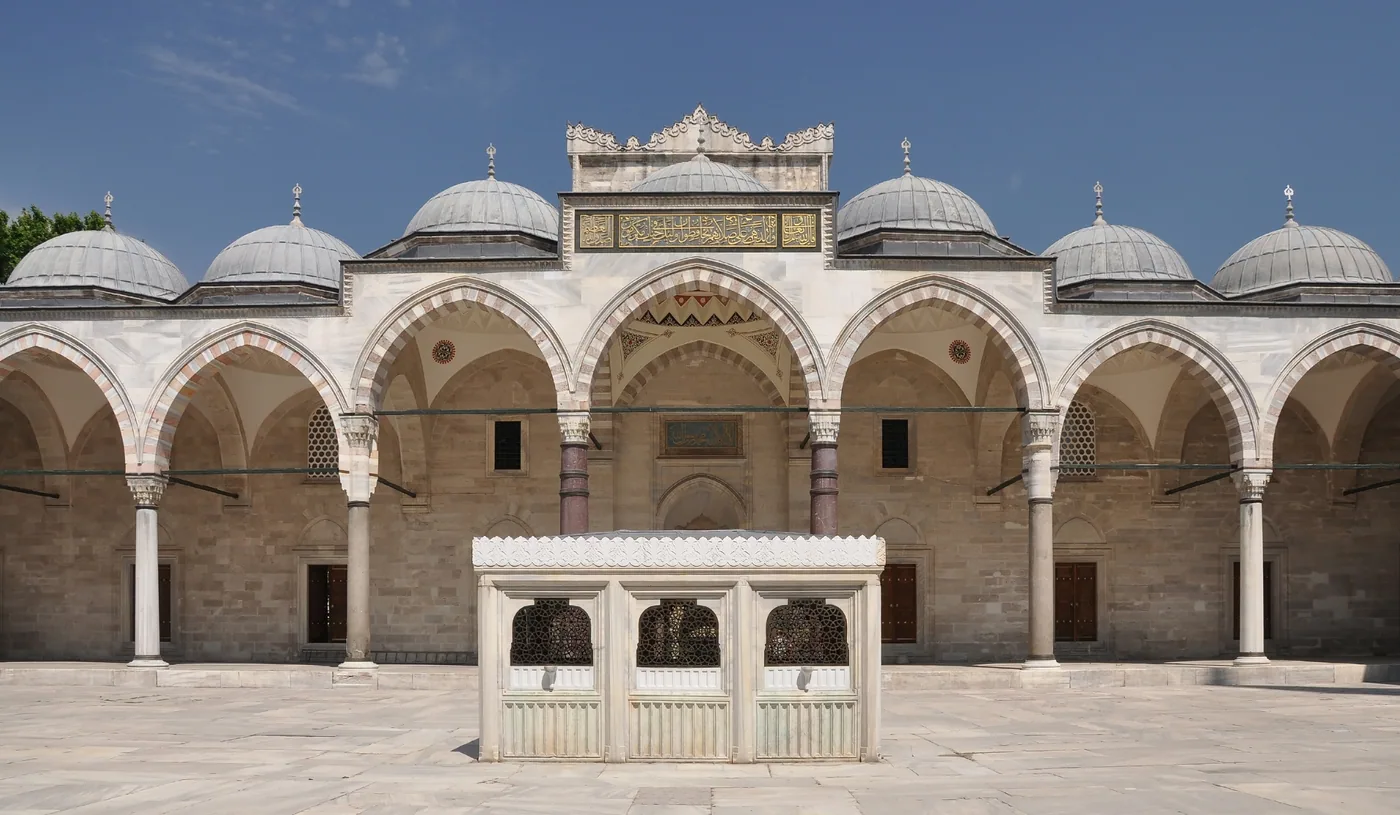
Süleymaniye is a lovely reason to leave the immediate Sultanahmet circuit. The climb from the waterfront takes you into another part of the old city, while the mosque’s courtyard and hillside setting give you space to pause. It is a major monument, but it rewards the same simple approach as a neighbourhood walk: leave time to look around.
Understand the setting
Built for Sultan Süleyman by the architect Sinan, the mosque was part of a wider complex rather than an isolated landmark. The surrounding institutions served religious, educational and everyday needs. The municipal heritage description explains that larger architectural ensemble.
You do not need to identify every former building to appreciate the idea. Notice how the mosque, courtyards, boundary walls and neighbouring streets fit together. The skyline view is impressive, but this is also a place shaped around movement, shelter and daily life. Seeing it at ground level adds something that a distant ferry photograph cannot.
A useful walking approach
From Eminönü, the route climbs through the streets above the Spice Bazaar. It makes an appealing walk if you are comfortable with gradients, but do not treat the short distance on a map as a flat stroll. Wear shoes you trust on uneven paving, carry water in hot weather and take breaks before the climb becomes a chore.
If you prefer to avoid climbing from sea level, compare a route from the university and Beyazıt side. It will not remove every slope, but it may fit more naturally with a Grand Bazaar day. Keep a saved map pin for Süleymaniye Camii and follow public streets; a building visible over a wall is not necessarily accessible through the nearest gate.
For anyone with limited mobility, ask about the accessible entrance and the route inside before travelling. A taxi can reduce the approach, but it does not establish that every courtyard, tomb or interior space is step-free.
What to notice at the mosque
Begin in the courtyard. Look at the repeated arches and the relationship between the fountain, open space and domes. Inside, the scale and balance are as important as individual decorative details. Let your eyes travel upward, then look back at how the great space is supported.
The Ministry’s historical account also describes the tombs associated with the complex and Sinan’s own tomb nearby. These help connect the building to the people behind it. Access to separate areas can vary, so make the mosque and courtyard the core visit rather than assuming every adjoining space will be open.
We suggest around an hour at the mosque and its immediate surroundings, plus the walk there and back. Add time if you enjoy drawing, reading about architecture or simply sitting outside. That is our itinerary allowance, not an admission timetable.
Visit with a little flexibility
This remains a working mosque. Dress modestly, bring a head covering if needed, remove shoes where instructed and give worshippers room. Follow attendants’ directions about tourist access and photographs. Prayer times change with the season, so be ready to explore the surrounding streets first and return later.
After the visit, choose one direction rather than retracing every hill. Walk downhill toward the Spice Bazaar and the ferries, or continue toward the university quarter and Grand Bazaar. Both give the mosque a place in a fuller day. If you have already visited the Blue Mosque, compare what you remember about their light, courtyards and proportions; the differences are more interesting than deciding which one is “best.”
Addresses & maps
Put it on your map
Süleymaniye Camii
Süleymaniye Mahallesi, Prof. Sıddık Sami Onar CaddesiFatih, Istanbul
The mosque is uphill from Eminönü. Allow for the climb and follow signs to the visitor entrance.